Last week I had the honor to hear Vic Gundotra speak in person and honestly — I’m still processing it.
If you don’t know the name – Gundotra was one of Google’s earliest key hires, a close collaborator with Steve Jobs, and one of the architects behind Google Translate. He also walked away from everything he knew to convert to Catholicism, losing his entire social circle and much of his family in the process. The man thinks in systems – engineering, faith, AI – and when he connects those dots, it’s worth paying attention.
His framing: AI is not just another tool. It is the single biggest transformation since the wheel was invented. And most of us are still treating it like a slightly smarter search engine.
The math that should change how you see this
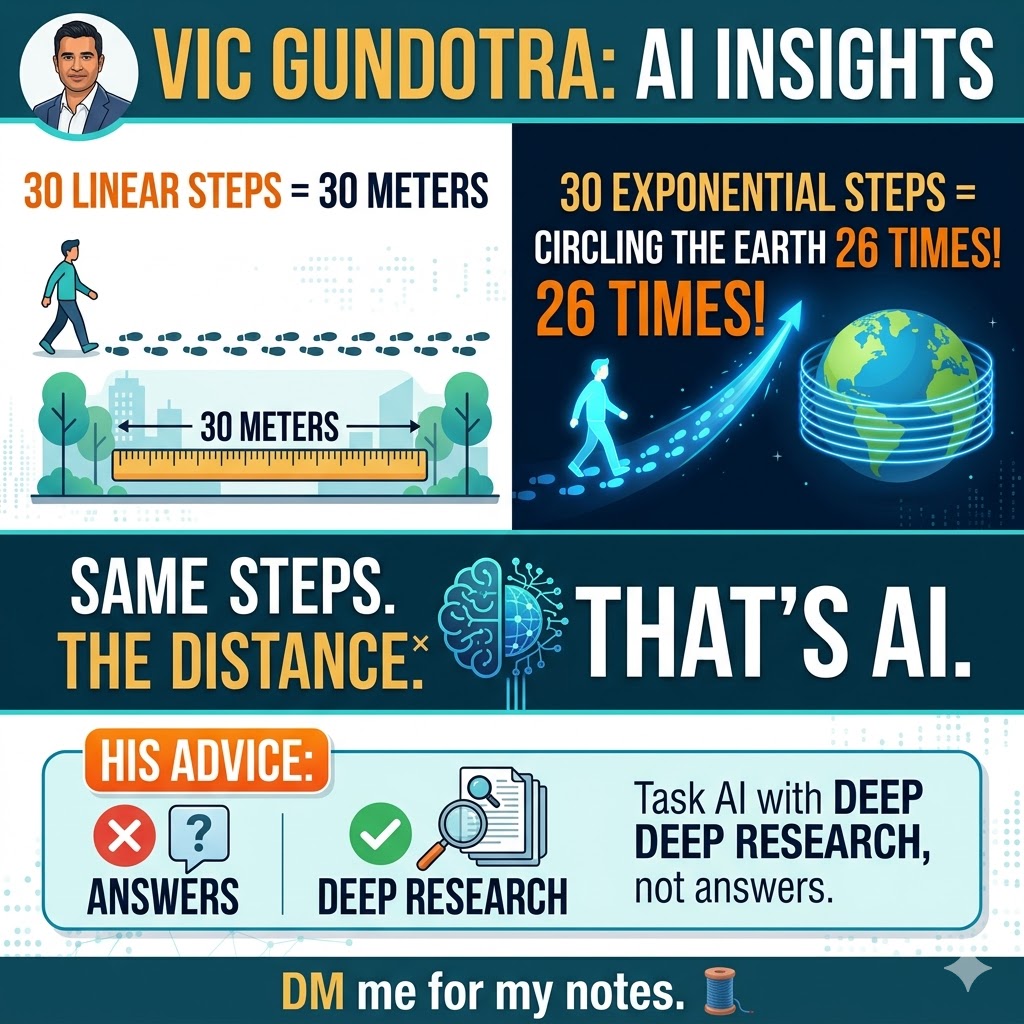
Here’s the thing about exponential growth that our brains refuse to actually process. Take 30 linear steps and you travel 30 meters. Take 30 exponential steps – doubling each time – and you travel over a billion meters. That’s enough to circle the Earth 26 times. Same number of steps. A ratio of 35 million to one.
That’s not a metaphor. That’s the trajectory we’re on according to Gundotra.
Gundotra explains that the old model of computing was simple: humans wrote explicit instructions and computers followed them. The new model – the one powering everything you’re hearing about right now – is different. AI learns through trial and error at massive scale. It isn’t told what to do. It figures it out. And it is getting better at a rate our linear brains are genuinely not wired to track.
The barrier to entry has already collapsed. He uses the example of a 13-year-old who built a business planned and a functioning business with a go to market strategy in a weekend using nothing but voice commands. No coding. No technical background. Just a kid with a clear idea and a tool that could execute it.
That kid is competing with your agents, your loan officers, and your affiliated partners. So are a lot of other people you haven’t met yet.
What this means for our industry specifically
Gundotra’s warning is not about AI replacing people. It’s subtler than that. He calls it the Knowledge Tsunami. Expertise is being commoditized. In a world where AI has access to more information than any human alive, the value shifts – from knowing things to directing things. From having answers to asking better questions.
That’s actually my number one takeaway from everything he said: don’t ask AI for answers. Task it with deep research. There’s a difference, and that difference is where your value lives.
The people in real estate, mortgage, title, and affiliated services who will win the next decade are not the ones who know the most. They’re the ones who can direct the best – who understand their client, their market, their relationship well enough to put AI to work in a way that a 13-year-old with no context simply can’t.
The part that should make us pause
Gundotra draws a parallel to Roman Roads – the infrastructure that allowed Christianity to spread across the ancient world. AI, he argues, is the new road system. Neutral in itself. Enormously powerful depending on who builds on it and with what values.
His concern is real: the large language models shaping this global library of knowledge reflect the culture and biases of the people who built them. We are not guaranteed an objective moral compass in that system. The question of “what is true” – Pilate’s question – is very much alive inside AI.
Which means the people who understand both the tool and their own values are the ones who need to be in this conversation. Not watching from the sideline.
The road is being built either way. The only question is whether you’re on it. Check out some of my thoughts on AI:
- Why Your AI is “Lazy”
- It’s All About That Prompt, Isn’t It?
- The Broken Rung: How AI is Changing Who We Hire
- Anthropic AI Phase 2: Why “Blue” is the New White
- AI Is Taking the Process. Your Job Is to Be Human
- The Last Hiring Cycle You’ll Run the Old Way
Want to hear more of what Vic had to say? And if you want to talk about how AI is showing up in our business right now — I’m always up for that conversation.

8 thoughts to “30 Steps. A Billion Meters. Why AI Is Nothing Like You Think.”