Why Experts Say Mortgage Rates Should Ease Over the Next Year

From my friends at Keeping Current Matters: “You want mortgage rates to fall – and they’ve started to. But is it going to last? And how low will they go?”

Experts say there’s room for rates to come down even more over the next year. And one of the leading indicators to watch is the 10-year treasury yield. Here’s why.

The Link Between Mortgage Rates and the 10-Year Treasury Yield

For over 50 years, the 30-year fixed mortgage rate has closely followed the movement of the 10-year treasury yield, which is a widely watched benchmark for long-term interest rates (see graph below):
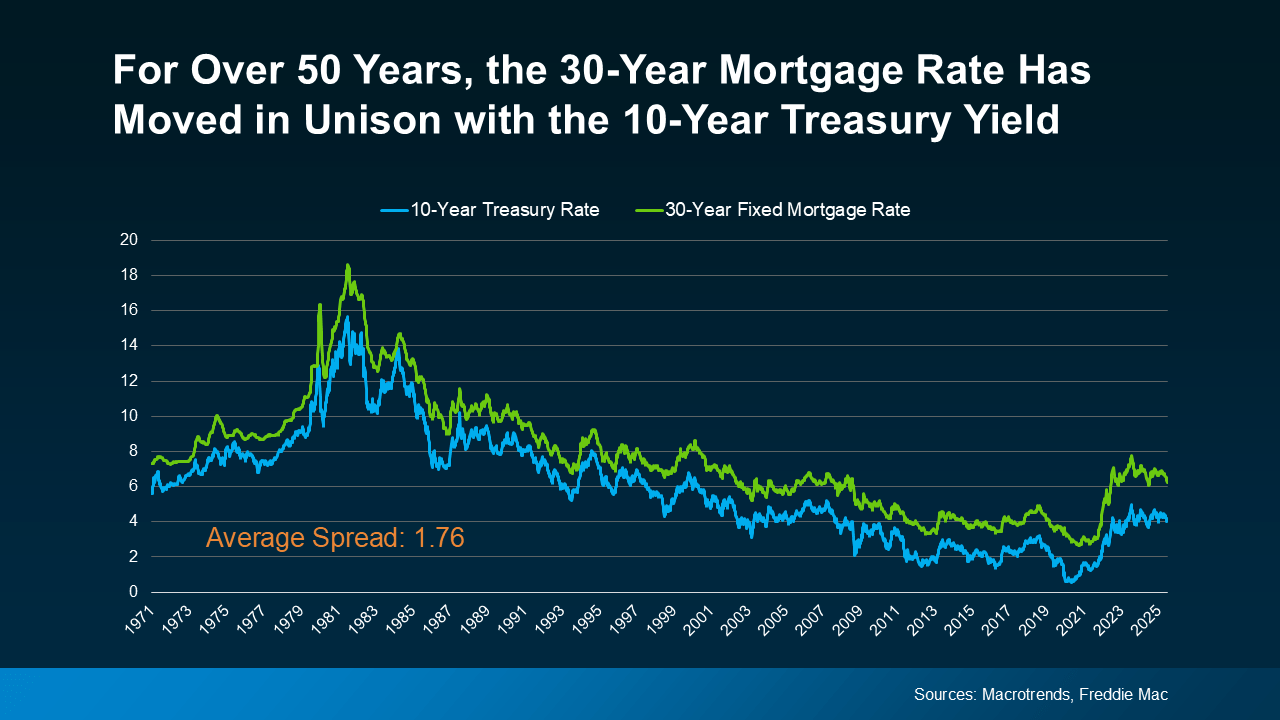
a graph of a graph showing the rise of a mortgage rateWhen the treasury yield climbs, mortgage rates tend to follow. And when the yield falls, mortgage rates typically come down.

It’s been a predictable pattern for over 50 years. So predictable, that there’s a number experts consider normal for the gap between the two. It’s known as the spread, and it usually averages about 1.76 percentage points, or what you sometimes hear as 176 basis points.

The Spread Is Shrinking

Over the past couple of years, though, that spread has been much wider than normal. Why? Think of the spread as a measure of fear in the market. When there’s lingering uncertainty in the economy, the gap widens beyond its usual norm. That’s one of the reasons why mortgage rates have been unusually high over the past few years.

But here’s a sign for optimism. Even though there’s still some lingering uncertainty related to the economy, that spread is starting to shrink as the path forward is becoming clearer (see graph below):
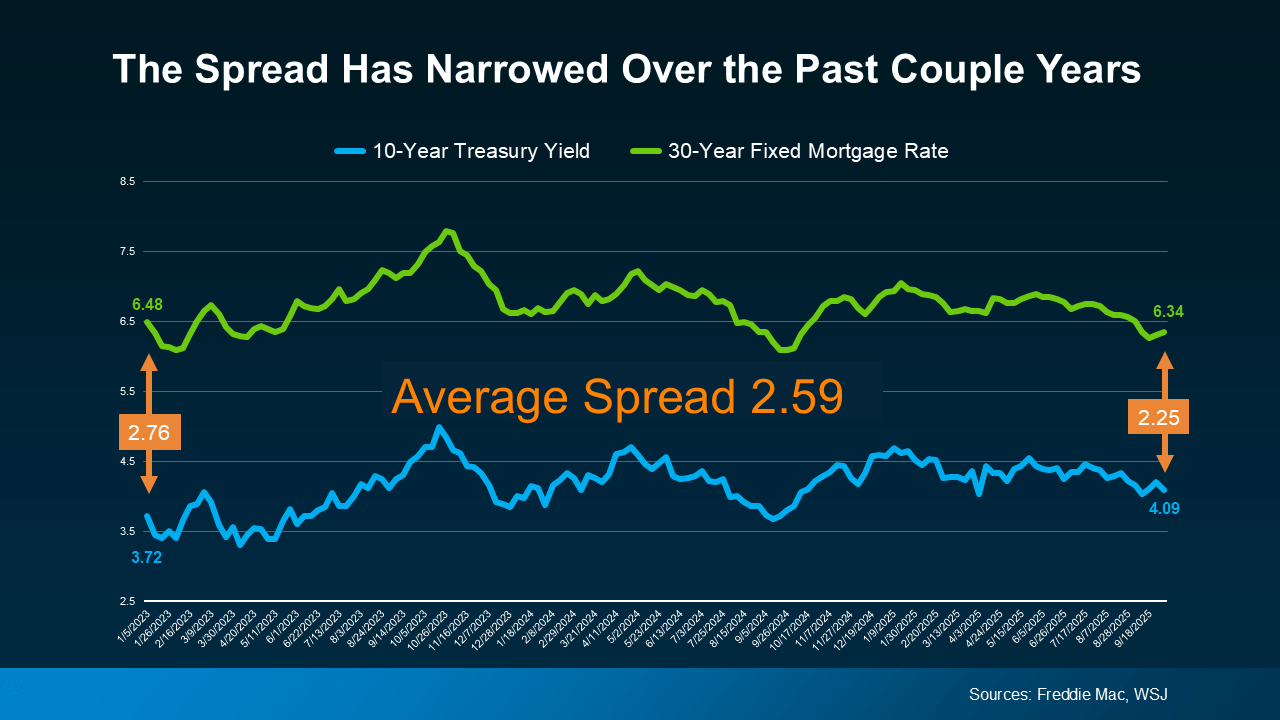
a graph of a chartAnd that opens the door for mortgage rates to come down even more. As a recent article from Redfin explains:

“A lower mortgage spread equals lower mortgage rates. If the spread continues to decline, mortgage rates could fall more than they already have.”

The 10-Year Treasury Yield Is Expected To Decline

It’s not just the spread, though. The 10-year treasury yield itself is also forecast to come down in the months ahead. So, when you combine a lower yield with a narrowing spread, you have two key forces potentially pushing mortgage rates down going into next year.

This long-term relationship is a big reason why you see experts currently projecting mortgage rates will ease, with a fringe possibility they’ll hit the upper 5s toward the end of next year.

Here’s how it works. Take the 10-year treasury yield, which is sitting at about 4.09% at the time this article is being written, and then add the average spread of 1.76%. From there, you’d expect mortgage rates to be around 5.85% (see graph below):
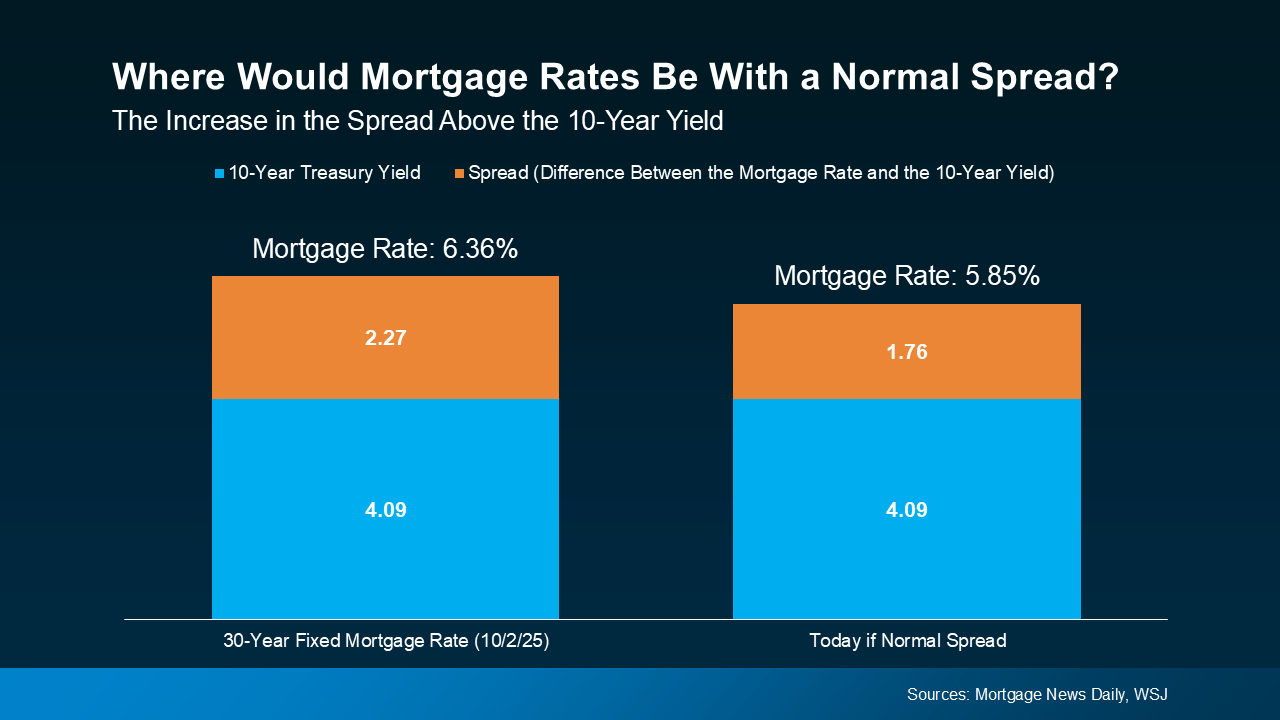
a graph of a chartBut remember, all of that can change as the economy shifts. And know for certain that there will be ups and downs along the way.

How these dynamics play out will depend on where the economy, the job market, inflation, and more go from here. But the 2026 outlook is currently expected to be a gradual mortgage rate decline. And as of now, things are starting to move in the right direction.

Bottom Line

Keeping up with all of these shifts can feel overwhelming. That’s why having an experienced agent or lender on your side matters. They’ll do the heavy lifting for you.


What's Possible?
What’s Possible?

Stop Selling Volume. Start Mastering Niche.

For my brokerage owners and elite agents, the latest C.A.R. 2026 California Housing Market Forecast isn’t just a set of numbers—it’s a data-backed mandate for strategic change. The era of high volume and effortless appreciation is over. The next three years are about constrained recovery, demanding surgical precision in your operations.

The forecast is telling us to stop waiting for 2021 volume and start maximizing profit from the current reality.


The Hard Truth: Sales Stabilize, Prices Rise, Affordability Dies

The market isn’t collapsing; it’s normalizing at a low equilibrium. This signals a hyper-competitive, high-price, low-inventory environment where the best-prepared brokerages win.

Metric 2026 Forecast Strategic Insight
Median Price $905,000 Appreciation is back (3.6% by 2026). Your sellers will get their price, but buyer qualification is paramount.
Sales Volume 274,400 Units Sales remain flat and low. Success is zero-sum. You must take market share through superior niche execution.
30-Year Rate Easing to 6.0% The “Golden Handcuffs” (low existing rates) are loosening only slightly. Inventory will remain tight, demanding a focus on Tax-Advantaged Seller Strategies.
Affordability Stuck at 18% The mass market is priced out. The three key target pools are the Wealthy, the Assisted, and the Strategic Seller.

A 3-Point Strategic Playbook

This forecast demands a shift from a generalized sales approach to a highly specialized, risk-managed business model. This is the Niche Mandate for talent attraction and profit protection.

1. Own the Niche: The Wealthy, The Strategic Seller, and The Assisted

Your agent training and lead generation budgets must be fully allocated to the three segments that offer the highest probability of closing:

  • The Wealthy Niche (28% of the Market): All-cash sales are at a 13-year high. Your top-tier agents need training in wealth management, high-end negotiation, and complex 1031 exchange structures. Pivot marketing dollars away from first-time buyer search engines and toward wealth-focused media and referral networks.
  • THE STRATEGIC SELLER NICHE (55+ Tax Transfer): This is the most overlooked, transaction-ready inventory pool in the state. Thousands of sellers aged 55+ are locked into low tax bases but are unaware of their ability to transfer that basis to a new home (via Prop 19). Your competitive advantage is becoming the expert who unlocks this equity.
    • Action: Implement mandatory Prop 19 certification training for all listing agents. Target outreach specifically at probate attorneys and financial advisors whose clients are in this age bracket.
  • The Assisted Niche (The New First-Time Buyer): 83% of consumers are unaware of Down Payment Assistance (DPA) programs. Your brokerage’s competitive advantage lies in becoming the local DPA and grant expert. This is the only scalable way to capture new buyer traffic.
    • Action: Launch an internal “DPA Authority Certification Program” to give new agents immediate, qualified client access.

2. Conquer the Transaction Killer: Insurance & Risk

The most overlooked threat to your GCI: The C.A.R. predicts a staggering 16.6% of transactions will fail due to insurance issues by 2025. This is no longer a post-offer checklist item—it’s a pre-offer deal-breaker. Stop letting operational failures kill veteran agent GCI.

  • Mandate Pre-Offer Insurance Vetting: Implement a “Pre-Offer Risk Assessment Checklist” policy requiring agents to secure preliminary insurance quotes and confirm insurability before submitting offers on properties, especially in rural, fire-risk, or second-home zones. This protects your veteran agents’ time.
  • Forge New Partnerships: Move beyond traditional lender/title relationships. Create strong alliances with Insurance Brokers specializing in high-risk property to fast-track solutions and prevent costly escrow fallouts.

Recruitment Pitch Consideration (Veteran Agents):

“Are you tired of losing two months of work on an uninsurable deal? Our systems protect your GCI. You’ll use your expertise on the highest-value opportunities, like the 55+ tax transfer (Prop 19) seller market and complex 1031 exchanges, with our risk mitigation guardrails in place.”


3. Coach Sellers Out of the “Golden Handcuffs” & Develop Agent Authority

The average seller is holding their home for 15.0 years. They are rate-locked and comfortable. Your listings agents must become consultants focused on life events and wealth strategy, not just transaction coordinators. This also creates a high-value apprenticeship path for new agents.

Equip Your Agents With Strategies to Overcome Inertia:

  • The Mobility Argument: Shift the focus from the new mortgage rate to the transfer of wealth. If a seller can unlock $500K in equity and use it to retire, invest, or move closer to family, the new mortgage rate is secondary.
  • The Tax Transfer Strategy (Prop 19): For sellers 55 and older, this is the ultimate inertia-breaking tool. Agents must lead with the question, “Do you know you can keep your low property tax base when you move?” This changes the conversation from “I can’t afford to move” to “I must move to capture this tax advantage.”
  • Strategic Acquisition (Buy Before You Sell): Train agents on the ethical and practical uses of bridge loans and HELOCs to enable the seller to acquire their next property before listing, eliminating the fear of being homeless and unlocking inventory.

Recruitment Pitch Consideration (New/Developing Agents):

“If you join us, you get operational expertise, not just a license. You become a certified DPA expert, giving you immediate skills to work with qualified first-time buyers. Plus, you tap into the 55+ tax transfer inventory by apprenticing with top producers and mastering our ‘Tax-Advantaged and Cash Strategy processes.'”


The Bottom Line: Execute the Niche Mandate

The 2026 Forecast is not a warning; it’s a clarification. It tells us precisely where the profitable segments of the market are. Your success over the next three years depends on your willingness to stop treating the market as a monolith and start deploying specialized, data-driven strategies focused on:

DPA + Tax Strategy + Cash Solutions = Market Leaders.

Action Item: Forward this analysis to your leadership team. Schedule a strategy session now to re-align your 2025-2026 training and marketing budgets. The time to pivot is now.

Do The Next Right Thing!

A Tale of Two Trends: Why Resilience and Experience Are Key

I like to cut to the chase and get to what’s really happening in the residential real estate market.

We’ve got a lot to unpack, from inflation woes to a surprisingly resilient housing landscape.


Macroeconomic Trends: A Mixed Bag

July’s numbers are in, and they’re a bit of a head-scratcher. Inflation is still on the rise, with both consumer and wholesale prices climbing. It seems to be a persistent threat that’s not going away anytime soon. Yet, despite this, retail sales are holding strong, a testament to consumer resilience. Small business optimism is also back on the upswing, even amid the uncertainty. This tells me that while there are headwinds, people are finding ways to adapt and thrive.


Housing Market Snapshot: A Look Around the Country

Let’s zero in on some market data:

National: The national picture is a bit more optimistic. Existing home sales increased by 2.0% in July, and the median home price was up 0.2% year-over-year to $422,400. Inventory also saw a slight bump, giving buyers more options. The key takeaway is that the national market is showing resilience, with sales inching up. Median days on market: 63

California: The market here is cooling off a bit, but it’s far from a crash. July home sales trailed last year’s levels for the fourth straight month, with existing single-family home sales at a seasonally adjusted annualized rate of 261,820. The statewide median home price was $884,050, a slight dip from both June and July of last year. While affordability remains a challenge, it’s a more balanced market where deals are still getting done. Median days on market: 63

Florida: Florida’s market mirrored broader trends. Closed sales for single-family homes were down 2.8% from July of last year. However, the statewide median sales price was $410,000, a modest 1.7% decrease year-over-year. The supply of homes is at 5.4 months, a sign of a more balanced market compared to the previous year. Median days on market: 91

Texas: In Texas, the market followed typical summer trends with sales slowing and prices adjusting. For example, Central Texas saw a 7.9% decrease in sales from July 2024, with the median price at $435,000, down 3.3%. However, new listings and active listings are up, which is great news for buyers and suggests a more balanced market. Median days on market: 77

New York: New York’s housing market is experiencing a shift: while the statewide median price was up 4.9% year over year to $451,000 in July, closed sales were down 2.3%. Median days on market: 56


A Look at Today’s Agents: Experience Matters

This is the part that should resonate with all of us. The latest National Association of REALTORS (NAR) report highlights a trend: the industry is getting older and more experienced. The median age of NAR members is now 57, up from 55 last year, and the median number of years of experience has increased to 12, up from 10.

This shift isn’t just about age; it’s about wisdom.

A majority of agents — 74%— are “very certain” they’ll stick with real estate for the next two years. This is a powerful signal. Despite market shifts, agents are not giving up. They’re hunkering down, leveraging their experience, and preparing to tough it out.

So, what’s the takeaway?

  • The market is shifting, not collapsing.
  • The agents who are succeeding are those with the experience and commitment to weather the storms.
  • This is a time to lean on your skills, adapt your strategies, and show your clients the value that only a seasoned professional can provide.
A System Will Produce What A System Will Produce, Nothing Less and Nothing More!

Your Edge in a Tough Market

Let’s cut to it: This market isn’t for the faint of heart. High rates, expanding inventory with higher days on market, demanding clients – it’s a grind. But for the sharpest brokers, recruiters, and agents, it’s also a massive opportunity to outpace the competition.

I’m borrowing and resharing the potent 3-2-1 structure and the inspiration for this content from James Clear, author of Atomic Habits and cofounder of Authors Equity. His June 26th newsletter and blog is a no-fluff way to deliver maximum impact in this market:


3 Ideas


I. Double Down on Your Hottest Lead.

“Start with the best opportunity available to you. If you make the most of what you have in front of you right now, better opportunities will become available as you go along.”

Forget chasing ghosts. Who’s that motivated seller you just spoke with? That agent candidate who’s actively looking to switch? The referral source who just promised you a warm intro? Stop scattering your energy. Nail that one thing first. Small wins build massive momentum, especially when the market feels stagnant.

II. Your Network is Your Net Worth. Period.

“Relationships are usually the most important thing. If you want to achieve more, there is some relationship that can unlock better results… Whatever you’re trying to accomplish, relationships are probably the key to getting there.”

In this market, transactions are harder-won. So, where’s your leverage? It’s your relationships. Are you consistently nurturing your top 50 past clients? Are you building genuine rapport with every lender, inspector, and title rep? For recruiters, are you actively connecting with team leaders and high-performers? Your next big deal or top recruit isn’t coming from a cold call; it’s coming from a cultivated connection.

III. The Toughest Days Are About Showing Up.

“Mental toughness is often framed as the perseverance that gets you across the finish line… But most days, mental toughness isn’t about crossing the finish line. It’s about getting to the starting line: Show up when no one is watching, Keep your eye on the ball, Do a little bit every day.”

Forget the Hollywood grit. Real mental toughness in real estate right now is the daily grind. It’s making those 20 prospecting calls when you feel zero motivation. It’s perfecting your listing presentation when listings are scarce. It’s following up with that lukewarm lead again. The market doesn’t reward the flashiest; it rewards the relentless. Don’t skip the “easy-to-skip” days.


2 Quotes


I. Stay Present: Stop Missing the Deal Right Here.

Jesuit priest Anthony de Mello nails it:

“Think of yourself in a concert hall listening to the strains of the sweetest music when you suddenly remember that you forgot to lock your car. You are anxious about the car, you cannot walk out of the hall and you cannot enjoy the music. There you have a perfect image of life as it is lived by most human beings.”

Source: The Way to Love

Are you so stressed about the next commission check or the looming market shift that you’re missing the opportunities, the client connections, and the joy of your actual work today? Be present in your current deal. Focus on the client in front of you, not the hypothetical next one.

II. Service First: That’s Where the Money & Meaning Are.

Poet Ellen Sturgis Hooper reveals a profound truth:

“I slept, and dreamed that life was joy; I woke, and found that life was service. I acted and behold, service was joy.”

Source: The Dial (July 1840)

This isn’t about being a martyr. It’s about strategic thinking. In a tough market, the agents, brokers, and recruiters who win are those who are problem-solvers. Who are you serving better than anyone else? How are you adding massive value? When you focus on helping others succeed – whether it’s a client buying their dream home or an agent building their business – the “joy” (and the income) follows.


1 Question


There’s a difference between feeling tired and feeling empty. One probably needs sleep. The other… purpose.

Are you low on rest or low on meaning?

This is your gut check. Are you simply grinding too hard and need a true break? Or is there a deeper void – a lack of connection to why you’re putting in these hours? If it’s the latter, stop. Reconnect with your core purpose.

  • Why did you get into real estate?
  • Who are you fighting for?

That clarity is your fuel in the lean times.

A System Will Produce What A System Will Produce, Nothing Less and Nothing More!

Tax Bill Update: What You Need to Know for Real Estate

Updated: July 5, 2025

As a coach and consultant to real estate broker-owners, C-suite executives, recruiters, and agents, I’d like to share an important update on the “One Big Beautiful Bill Act.” This significant tax reform legislation has successfully passed through both the U.S. Senate and the House of Representatives and has been signed into law by the President.

This bill isn’t just another piece of legislation; it’s packed with provisions that will profoundly impact the real estate sector, influencing homeownership incentives, shaping investment strategies, and redefining the operational landscape for real estate professionals like us. The National Association of REALTORS® (NAR) truly went to bat for our industry, and their advocacy efforts certainly paid off.

Let’s dive into the key provisions that will directly impact real estate and homeownership.

Key Provisions Directly Impacting Real Estate and Homeownership

The “One Big Beautiful Bill Act” brings a mix of permanent and temporary changes designed to influence both individual taxpayers and businesses within our real estate world:

  • Permanent Extension of Lower Individual Tax Rates: This is big for everyone. By maintaining existing lower income tax rates for individuals, this translates into more disposable income for potential homebuyers and current homeowners. More money in their pockets means stronger demand and improved affordability – a win-win!
  • Enhanced and Permanent Qualified Business Income (QBI) Deduction (Section 199A): This is fantastic news for many of you operating as independent contractors or through pass-through business structures. The permanent 20% QBI deduction offers consistent, long-term tax relief. This makes a career in real estate even more financially attractive for self-employed professionals, helping with talent attraction and retention.
  • Temporary Quadrupling of the State and Local Tax (SALT) Deduction Cap (Beginning 2025): This is a huge relief for homeowners in high-tax states! The SALT deduction cap is jumping from $10,000 to $40,000 for households earning under $500,000. While temporary (lasting through 2029 with a 1% inflation adjustment after 2025, reverting to $10,000 in 2030), this offers substantial tax relief, potentially freeing up significant funds for housing-related expenses. Plus, the bill safeguards the ability for businesses to deduct state and local taxes paid through state-enacted pass-through entity taxes.
  • Permanent Extension of the Mortgage Interest Deduction (MID): The MID continues to be a permanent tax provision, allowing homeowners to deduct interest paid on the first $750,000 of mortgage debt. Even better, it restores the ability to deduct mortgage insurance premiums! This ensures a long-standing incentive for homeownership remains firmly in place and is even stronger.
  • Protection for 1031 Like-Kind Exchanges: No changes here, and that’s great news! The bill explicitly maintains and protects 1031 like-kind exchanges. This critical tool allows real estate investors to defer capital gains taxes on investment property sales, supporting ongoing investment activity in our markets.

Other Relevant Measures with Broad Housing and Economic Impacts

Beyond the core real estate items, there are other provisions in the bill worth noting due to their broader economic and housing implications:

  • Low-Income Housing Tax Credit (LIHTC) Enhancements: This is a major boost for affordable housing initiatives. The bill permanently increases the LIHTC’s state allocation to 12% and lowers the bond-financing threshold to 25% beginning in 2026. These provisions are expected to significantly support and stimulate the development of affordable housing, with some analysts projecting the creation of around one million affordable units!
  • New Provision for Condominium Developers (Completed Contract Method): This is a significant win if you’re involved in condominium development! The bill now allows developers to use the completed contract method for reporting income from sales of to-be-built condominiums, rather than the percentage-of-completion method. This means income is taxed when the sale actually closes and proceeds are received, providing much better cash flow management and potentially incentivizing more new construction.
  • Child Tax Credit Increased to $2,200: While not directly real estate, this permanent increase, with inflation indexing, indirectly helps housing affordability for families by increasing their overall financial capacity and disposable income. Happy families mean stable housing.
  • Permanent Estate and Gift Tax Threshold Set at $15 Million (Inflation-Adjusted): For those involved in wealth transfer, this measure stabilizes the exemption level at $15 million per person for individuals dying or gifts made in 2026, with continued inflation indexing after 2026. This provides greater certainty for estate planning, particularly when dealing with substantial real estate assets.
  • Strengthened Opportunity Zones: Good news for targeted investment! The bill establishes a permanent policy for Opportunity Zones that creates a recurring 10-year designation period beginning in 2026. It also eliminates the December 2026 sunset date for deferring capital gains, allowing investors to defer gains for up to five years or until the investment is sold, fostering long-term economic development in designated areas.
  • Termination/Phase-out of Certain Energy Credits: This is an important detail for new home construction and energy-efficient upgrades. The bill includes the termination of the Electric Vehicle Credit as of September 30, 2025, and the elimination of the Section 45L New Energy Efficient Home Tax Credit and the Section 25D Residential Clean Energy Credit after June 30, 2026, and 180 days after enactment, respectively. Keep this in mind for future projects and client advice.
  • Restoration of Key Business Provisions (Bonus Depreciation): The bill reinstates 100% bonus depreciation, allowing businesses to fully deduct the cost of qualifying property components (like certain renovations or improvements) in the year they are placed in service. While primarily for commercial properties, this can significantly impact real estate investors and developers.

Strategic Considerations for Your Business

With the “One Big Beautiful Bill Act” becoming law, these tax changes are no longer theoretical – they are happening. Proactive planning is absolutely essential:

  • For Agents: Understanding the specifics of these tax provisions allows you to provide informed and accurate guidance to clients on potential financial implications related to homeownership, investment properties, and business operations. This knowledge will solidify your position as a trusted advisor.
  • For Broker-Owners and C-Suite: Now is the time to analyze how these changes could influence market demand, operational costs, and your ability to attract and retain talent, especially those operating as independent contractors benefiting from the enhanced QBI deduction. The increased SALT cap and MID provisions may also bolster buyer confidence in certain markets, so consider how to leverage that.
  • For Recruiters: The QBI deduction and other individual tax rate provisions significantly enhance the financial attractiveness of a real estate career, particularly for self-employed professionals. Make sure you highlight these robust financial benefits in your recruitment pitches!

The “One Big Beautiful Bill Act” represents a substantial shift in the tax landscape with direct and indirect implications for the real estate industry. Staying informed and adapting your business strategies will be crucial for success in this evolving environment. I will continue to provide detailed analysis as the bill is officially signed into law and its full impact begins to unfold. Stay tuned!

What's Possible?
What’s Possible?

A Broker’s Briefing: California’s Mid-2025 Economic & Real Estate Outlook

For California real estate professionals, the mid-2025 market is a story of critical divergences that demand close attention. While existing home prices are hitting all-time records and sales are up due to inventory rising for the first time in nearly a decade, the new-build pipeline faces significant hurdles.

The primary challenge is on the supply side. Citing uncertainty over tariffs and high material costs, home builder sentiment is pessimistic, driving new housing permits down to their lowest levels since 2015. This suggests that while large-scale residential projects like Silverwood in Hesperia and Related Bristol in Santa Ana are proceeding, the broader flow of new single-family inventory may remain constrained. However, a potential bright spot for buyers is the forecast for one or two Federal Reserve rate cuts before year-end, which could provide much-needed mortgage rate relief and boost demand.

Broader economic trends are shaping the client landscape. While the state is expected to avoid a recession, it faces a major budget deficit, and the job market is shifting dramatically. Healthcare is the main sector adding jobs, while the tech industry has seen significant layoffs due to the adoption of AI. This employment shift could influence buyer demographics and demand across different regions.

On the commercial side, the office market remains weak but is finally showing signs of a turnaround in utilization in key markets like Orange County and San Diego County.

The Takeaway for Agents: The current market requires educating clients on a complex picture. The key opportunities lie with the rising inventory of existing homes and potential rate cuts. The primary challenge is the scarcity of new construction, which will likely keep upward pressure on prices for the foreseeable future.

Source: Analysis inspired by “The Economic Outlook for California at Mid-Year” (June 2025) by Mark Schniepp, California Economic Forecast.

Follow Up
Follow Up

Slow Start to California’s Housing Season as Prices Reach New Highs

The California housing market is experiencing a sluggish beginning to the season, with home sales seeing a year-over-year decline for the second time in four months. This slowdown is attributed to a combination of elevated interest rates and persistent economic uncertainty. The condominium market, often a more accessible entry point for first-time buyers, has also seen a softening as affordability and insurability black lists continue to widen.

Market at a Glance

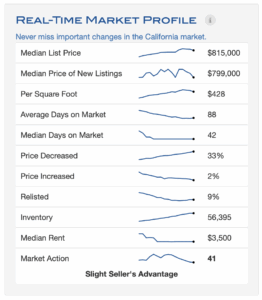
Recent data from the week ending May 31, 2025, shows a dynamic yet challenging market. On a daily basis, there were 556 closed sales, 548 pending sales, and 768 new listings. The median list price for a home in California has now reached $815,000, with the price per square foot at $428. Homes are sitting on the market for an average of 88 days, with a median of 42 days.

Despite the high prices, the market action index indicates a “Slight Seller’s Advantage” at 41, a figure that has remained steady from the previous month. This suggests that while sales have slowed, inventory remains relatively tight, keeping prices firm. Total inventory across the state is currently holding at around 56,395 homes.

REALTORS® Activity and Outlook

In the previous week, real estate professionals saw a mixed bag of activity. While 33.8% of REALTORS® listed a property, a 10% increase, and 24.6% closed a sale, up 12.1%, the number of those entering escrow saw a slight dip of 0.4% to 13.8%.

Looking ahead, REALTOR® sentiment reflects the market’s uncertainty. A significant 46.9% of REALTORS® anticipate that listings will increase, a rise of 3.7% from the previous quarter’s sentiment. However, there is less optimism about sales and prices. Only 23.4% expect sales to go up, a 4.1% decrease in positive sentiment, and a mere 9.4% believe prices will rise, a substantial 9.4% drop in confidence from the last quarter.

A Look at Housing Affordability

A significant factor contributing to the market’s slow start is the increasing difficulty for many Californians to afford a home.

In 2024, less than one-fifth (18%) of all Californian households could afford to purchase a median-priced home of $865,440. To afford such a home, a minimum annual income of $221,200 is required to manage the estimated monthly payment of $5,530, assuming a 20% down payment and a 6.84% interest rate.

The ability to afford a home varies across different ethnic groups. In 2024, 21% of White households could afford a median-priced home, compared to 27% of Asian households, 10% of Black households, and 9% of Hispanic/Latino households.

Economic Headwinds

The broader economic landscape presents a mixed but cautious outlook. While consumer confidence has seen a partial rebound, CEO confidence has fallen due to concerns over geopolitical instability and tariffs, with many predicting a recession in the next 12 to 18 months. Although a key inflation gauge is easing, potential price hikes from major retailers could reverse this trend. These factors are keeping mortgage rates high, causing a stall in the housing market as both buyers and developers adopt a “wait and see” approach, evidenced by a third consecutive monthly decline in construction spending.

Sourced from the California Association of REALTORS® and Altos Research.

California Housing Market

Tax Bill Advances in House: Implications for the Housing Sector

The House of Representatives recently passed the “One Big Beautiful Bill Act,” a legislative package featuring several tax provisions with notable implications for the housing industry, homeownership, and real estate investment.

Key Tax Provisions Impacting Real Estate:

The bill includes several measures relevant to the housing sector:

  1. Enhanced Qualified Business Income (QBI) Deduction: The deduction for pass-through entities, which includes many real estate professionals and small businesses in the housing sector, is set to increase permanently from 20% to 23%.
  2. Modified State and Local Tax (SALT) Deduction: The cap on SALT deductions would be quadrupled from $10,000 to $40,000 for households earning under $500,000, with planned annual growth. This change could impact homeowners in areas with higher property and state income taxes.
  3. Permanent Individual Tax Rates: Current lower individual income tax rates are slated to become permanent and indexed for inflation, a factor that can influence overall housing affordability.
  4. Mortgage Interest Deduction (MID) Maintained: The existing deduction for mortgage interest is preserved at its current level and made permanent, continuing a long-standing tax consideration for homeowners.
  5. Treatment of 1031 Like-Kind Exchanges & Business SALT: Section 1031 like-kind exchanges, a provision often utilized in real estate investment, are protected. Current state and local tax deduction rules for most businesses are also largely unchanged, though some limitations are introduced for certain high-income professional services, which are not anticipated to significantly affect most real estate businesses.

Additional Provisions Relevant to Housing and Investment:

The legislation also contains other measures that could influence the housing market and real estate investment:

  • Affordable Housing Support: Includes enhancements to the Low-Income Housing Tax Credit (LIHTC) to encourage the development of affordable housing.
  • Family Financial Measures & Home Purchase Incentives: Features an increased Child Tax Credit (to $2,500 through 2028, then inflation-indexed) and introduces new tax-advantaged Child Investment Accounts, which could be used for expenses such as first-time home purchases.
  • Investment and Estate Planning: Establishes a permanent $15 million (inflation-adjusted) estate and gift tax threshold and renews incentives for Opportunity Zones, aimed at encouraging investment in designated communities.
  • Business Tax Environment: Restores several business tax provisions, including those for R&D expensing and bonus depreciation. The bill does not include an increase in the top individual tax rate or changes to the tax treatment of carried interest.

These provisions, aimed at supporting homeowners, real estate professionals, and community development, will now move to the Senate for further consideration. If enacted, this bill could significantly shape the financial landscape for the housing industry and those involved in it.

What if?
What if?

Embracing Character: The Rising Appeal and Opportunity in Mature Homes

In today’s dynamic housing market, a fascinating trend is emerging: the growing prominence of mature homes. As of 2024, the typical home finding a new owner has a rich history, a testament to its enduring appeal and the evolving landscape of American housing, according to a recent assessment by Redfin. While the price difference between these character-filled dwellings and their newer counterparts has shifted, this opens up exciting opportunities for savvy homebuyers.

The data, spanning from 2012 to 2024, reveals a notable increase in the age of the median home purchased. This isn’t just a statistic; it’s a reflection of a market where established homes in desirable neighborhoods are increasingly in the spotlight. Two key factors contribute to this trend: the inherent affordability that mature homes often present compared to new constructions, and a period of more measured new home development following the Great Recession.

Sheharyar Bokhari, a Senior Economist at Redfin, notes, “America’s housing stock is getting older by the year.” While this is partly due to the pace of new construction, it also highlights a unique chance for buyers to invest in homes with stories to tell and craftsmanship from different eras.

A New Chapter for Homes with History

In 2024, the median age of a purchased home reached 36 years, the highest on record, as detailed in Redfin’s report. This means that many buyers are discovering the unique charm of homes built several decades ago. Specifically, the typical single-family home bought last year was 36 years old, condos averaged 38 years, and townhomes were a younger 23 years old. This is a shift from 2012, when the median age for all homes purchased was 27.

This embrace of established homes varies across the nation. For instance, in Buffalo, New York, buyers are finding value in homes with a median age of 69 years, dating back to 1955. Conversely, areas like Provo, Utah, showcase newer inventory, with a median construction year of 2018. This diversity offers a wide spectrum of choices for discerning buyers.

The Evolving Landscape of New Construction

The early 2000s saw a significant boom in residential construction, with nearly 15% of all existing homes built between 2000 and 2009. Following the 2008 financial crisis, the pace of new construction moderated, with about 9% of current homes built between 2010 and 2019. This was the smallest share of new homes added in several decades, according to Redfin’s analysis.

Looking forward, the period between 2020 and 2023 saw 3.1% of existing homes being newly built. While the pace of new construction continues to adapt to market conditions and economic factors, including recent tariff discussions that could influence building costs, the existing housing stock offers a wealth of opportunities.

Discovering Value in Established Properties

It’s true that traditionally, brand-new homes (less than 5 years old) have come with a higher price tag than those with more history (30+ years old). While this remains the case, the premium for newness has seen an adjustment. In 2024, the median price of a newer home was 31.6% more than an older home. This is a narrower gap compared to 2012, when new homes commanded a 77.9% premium. This evolving dynamic means that the unique value proposition of older homes is becoming even more apparent.

Choosing an established home can be an exciting journey. While they may not always feature the very latest contemporary finishes out of the box, they often reside in mature neighborhoods with established trees, community amenities, and unique architectural styles that newer developments may take years to cultivate. As Redfin Premier agent Jerry Quade alluded to, understanding the condition of an older home is key. This presents a fantastic opportunity for buyers to personalize their space, make updates that reflect their taste, and build equity through thoughtful renovations.

Bokhari further commented on the financial considerations, stating, “Without more construction, buyers are forced to choose from a pool of aging properties that present a new set of financial challenges, especially for those trying to save enough money to climb onto the property ladder.” However, this can also be viewed as an opportunity. Buyers who are willing to invest some TLC into an older property can often secure a home in a desirable location and create a space that is truly their own, often with a more manageable initial purchase price. The character, craftsmanship, and potential for personalization in older homes offer a rewarding path to homeownership and a chance to breathe new life into a property with a rich past.

Source: Based on an analysis of MLS data by Redfin

What's Possible?
What’s Possible?

Adapting to Change: Key Insights from Redfin’s 2025 Real Estate Agent Survey

An internal analysis by Redfin, based on its 2025 Industry Survey conducted by Jason Aleem, sheds light on the current state of the real estate industry from the perspective of non-Redfin agents. The company states it conducts these surveys to understand broader industry trends and agent needs.

The survey, fielded between December 2024 and January 2025, included 500 agents across 46 states who closed at least one deal in 2024. Respondents typically had over 10 years of experience, and 83.8% worked full-time.

Key Findings from the Redfin Analysis:

  1. Agent Performance: Despite a market slowdown, experienced agents appeared to consolidate business. 58% earned over $50,000 in 2024 (up from 49% in 2023), and nearly 30% earned over $100,000 (up from 22%). More agents (72.2%) closed 5+ deals, potentially due to fewer new agents entering (17% had <3 years experience vs. 28% in 2021). However, over a third still held a second job.
  2. Brokerage Choice: Commission splits are paramount (78.4% rate as very important), outweighing brand reputation (55.2%) and training/support (54.6%). Agent movement remains high, with 15% planning to switch brokerages in 2025 and 13.4% having done so in 2024. Notably, 54.8% of agents indicated they’d prefer lower brokerage support investments for a better split.
  3. Career Sentiment: Enthusiasm has declined. Only 21.2% are likely to recommend real estate as a career, versus 49.8% unlikely, resulting in a Net Promoter Score of -28.6, noted by Redfin as the lowest they’ve recorded. Top dislikes included income unpredictability (42.6%) and difficulty finding clients (37.8%). Independence (86.8%) and helping clients (76.4%) remain key motivators.
  4. Industry Headwinds: Affordability is the top challenge (64.2% major concern), followed by lack of inventory (42.8%) and declining commissions (42%). Redfin notes this aligns with its separate research on housing affordability.
  5. Policy & Economic Outlook: Agents widely support affordable housing policies (75.6%) and building more homes (66.8%), but less so for denser zoning locally (40% disagree). Opinions on the 2025 market are cautiously optimistic (around 50% expect local sales/prices to rise), while views on the overall U.S. economy are split (40.6% positive, 39.6% not).
  6. Climate & Insurance: Climate change impacts buyer decisions according to 39% of agents (higher in FL/CA), yet few (<10%) reported climate-risk training. Insurance issues during transactions increased for 47% of agents (72%+ in CA/FL), though 37.6% reported no client insurance problems.
  7. Discrimination: Reported experiences increased. 22.4% of agents reported sexism (up from 18%), with 34.5% of women reporting it versus 8.9% of men. 38% of non-white agents reported racial discrimination (up from 32%), often citing other agents/industry professionals (28%).
  8. NAR & Commissions: Views towards NAR turned significantly negative (51% unfavorable, up from 19% in 2023), likely linked to the commission settlement. 38% felt the changes negatively impacted their business, and 54.4% observed more commission negotiation. While Redfin states its data shows limited buyer commission changes yet, 51.2% of surveyed agents expect commissions to decline within 12 months. Most agents (74.8%) believe withholding listings from the MLS is rarely best for sellers. (Note: Survey conducted before the March 25 NAR rule update).

Source: Internal Redfin analysis of its 2025 Industry Survey by Jason Aleem. The anonymous survey was conducted via email by Ipsos between Dec 2024-Jan 2025, involving 500 non-Redfin agents across 46 states with at least one transaction in the prior 12 months.

What's Possible?
What’s Possible?