America’s happiest cities. Researchers for decades have studied the science of happiness and concluded that some of the key ingredients include: a positive mental state (a growth mindset); strong social connections; job satisfaction; health, and financial stability. One study suggests the incremental amount of happiness stops at around $75,000 of annual income.
Many factors affect our happiness, so the study included a panel of experts who commented on various aspects of happiness, like:
Can money buy happiness? No. The consensus: it’s far more important to have a sense of purpose and a way to give back.
Does happiness increases or decrease with age? Yes. The consensus seemed to be a trend of more happiness in younger and older individuals and less in the 40 and 50 age group! Maybe the burden of providing for the family?
Does where you live influence happiness? The consensus was yes with a footnote. So research suggests it’s not about the place, but the match between the place and who you are as a person combined with the family and friend connections.
I’ve lived in 8 states (VA, CO, TX, KY, OH, MI, CA, and MN) and 10 cities, and what I’ve found? Grow where you are planted! Every city, state, and region has a history, a story and a community. As I recall, Abraham Lincoln said it best:
Do it until… is the most common denominator for success in anything.
Some of us learn fast, others slowly, and many of us in between. When you are committed to the cause, the effort, and the result, “you do it until ___.”
Fill in the blank; you do it until you gain mastery; you do it until you have confidence; you do it until you are the best!
The common denominator is “I did it until I got it! It doesn’t matter how long it takes.” This is a great growth mindset.
You don’t know how long or short it will take to become an expert, yet if you keep doing what needs to be done – one day at a time – one hour at a time – one minute at a time, one second at a time – eventually all those seconds add up to minutes and minutes add up to hours and so on.
It’s not about how long it takes – if we keep doing what needs to be done – eventually, we get there, and we win.
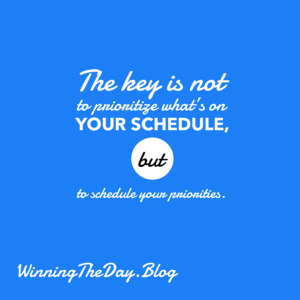
“The key is not to prioritize what’s on your schedule, but to schedule your priorities.” ~ Stephen Covey
Have you ever worked backward from Friday? At the end of the week, imagine you are sitting down and looking back…what would make this week great?
We can’t control the market this week, yet we can control the daily activities that lead to our expected outcomes.
I’m sure you would agree – without a doubt – we are in uncertain times. The paradox is this: we need both uncertainty and certainty in our business. Yet, from the conversations I’ve had this week, we have more uncertainty than certainty. How can we create more certainty?
If you show up for the day with no structure in your calendar and decide to do “urgent” tasks like returning calls and texts and checking Facebook, those activities will expand and eat up all the time you hoped to devote to more “important” activities. You will end the day unfulfilled and have more uncertainty. Get clear on what you want, make it part of your everyday routine, and have a plan for when you feel stuck or lost. That is a winning formula.
The key is not to prioritize what’s on your schedule but to schedule your priorities.
The key is not to prioritize what’s on your schedule, but to schedule your priorities.
Has anyone seen a home seller? Home sellers seem to be just about as rare as the Condor (unlike the red-tail hawk on my fence this morning).
Inventory of available homes for sale across the US fell another 2.5% this week, the lowest since 2019. This is the time of year when we traditionally see more homes coming on the market. Yet, according to Altos Research, there is no indication of an inventory surge coming into the market. Say what?
It is a supply-constrained market. Consumers are price sensitive to interest rates – now near 7% – and it seems sellers sitting on 3% mortgages are not motivated to trade up or out.
The result? 20% fewer homes in the pending process compared to a year ago. Only about 31% of sellers are needing to reduce their initial list price. The median price of new listings is up, yet not near the pace of increases we saw just a year ago. Rents appear to be stabilizing and slowing at the median level of $2,200 per month.
Ten excuses the top 1% all made, yet figured out a way to bust through:
1. I don’t have time
2. I don’t have the money
3. I will try it next year
4. I don’t have enough data
5. I am too tired, skeptical, or biased
6. No one ever did it before
7. It’s too much work
8. I could fail
9. I will wait until I retire
10. It’s too risky
You can bust through too. One of my associates told me all of these “excuses” are rooted in some sort of fear, so really the top 1% are masters of fear.
Near-death by a car accident, boot camp, Kilimanjaro Summit day, Hellmecula, Snowmageddon, Spartan Beast, crazy markets, and so much more.
Some things are just hard, and you want to quit.
I’ve made it through some tough situations with this one strategy: looking only a few steps, tasks or minutes ahead.
“Doing the next right thing.”
At certain times tunnel vision is a good thing.
Consider this – the next time getting through a challenge that seems like it might be too much for you. Lower your gaze to whatever the next minute, step, or task is right in front of you. Then take it.
There are times when big-picture thinking is needed. Yet the moments when you doubt you have the strength or the desire to put one foot in front of the other isn’t among them.
Focused Time. The top 1% know that less is more! Say what?
Who would you imagine to be more productive—someone who works 55 hours a week or someone who works 70?
If you guessed the latter, you’d be incorrect. Research done by Stanford showed that productivity diminishes after 40 hours and falls off a cliff after 55 hours. In essence, less is more.
Resource? Life on The Wire by Todd Duncan – in his book Todd challenges the status quo in search of a better, smarter way to work and live.
When you are inconsistent, nothing works at the optimal level.
Here’s what I know: recruiters, talent attraction coordinators, team leaders, managers, and real estate sales professionals who consistently set and attend appointments are producing more results, period. These leaders are consistent and disciplined in their daily prospecting and marketing routines.
Consistency… social media does not work if you are not consistent; geographic farming does not work if you are not consistent; repeat and referral does not work if you are not consistent; open houses will not work if you are inconsistent; online leads – a waste – if you are not consistent; recruiting and talent attraction is a roller coaster without consistency.
Show me something in your business that works when you are inconsistent.
Anything you are going to do, the more consistent you are with your mindset, attitude, approach, expectation, strategy, and tactics, the more predictable the result.
Bottom line: when you are consistent, everything works… when you are inconsistent, nothing works.
So my question is, what have you been inconsistent with?
What has that inconsistency cost you financially, emotionally, or physically?
I’d submit that the action we can all take is to be more consistent in creating, setting, and attending more new appointments.
We cannot control the market.
We can control ourselves, our thoughts, and our actions.
Next Steps:
Make an appointment-setting goal for the next 2 weeks and share it with an accountability partner.
Gather your past client list, all of your past leads, open house registers, and people you know, and start making appointments today.
Be CONSISTENT… list the 1, 2, or 3 things you must do consistently to propel your business forward.