In a world full of noise, fear, and fast-talking sales pitches, what is the single greatest asset you can possess? It’s not your database size. It’s not your market share. It is unwavering, undeniable integrity.
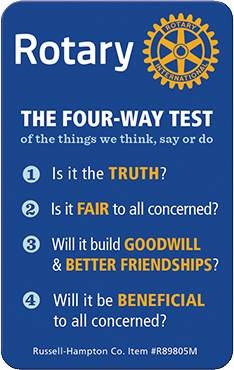
For nearly a century, the Rotary Four-Way Test has been the standard of ethical conduct. It was originally created in 1932 by Rotarian Herbert J. Taylor to save a company facing bankruptcy by resetting its moral compass. It worked. It can work for you.
The Test is simple – just 24 words – but its depth will force you to examine every thought, word, and action. If you want to achieve success that lasts, you must measure yourself against these four questions.
1. Is it the TRUTH?
In a business where information is currency, truth is the bedrock of trust. This isn’t about avoiding a lie; it’s about eliminating even the slightest exaggeration or omission.
Are you presenting market data accurately, or are you cherry-picking stats to make a sale?
Are you fully disclosing a property’s known defects, even if it complicates the transaction?
Are your advertisements truthful, or are they relying on hype and vague superlatives?
If you have to pause for longer than a second to answer, you’re not operating with the integrity required for long-term survival. Trust is built with truthful actions; it is destroyed with a single deceit.
2. Is it FAIR to all concerned?
This is where many professionals trip up. Fairness is not about winning the negotiation; it’s about achieving an outcome that respects the interests of every party at the table—your client, the co-op agent, the buyer, the seller, and the vendors.
Are you pushing a client toward a decision that benefits your commission more than their bottom line?
In a multiple-offer scenario, are you managing the process with transparency, even when under pressure?
Are you respecting the time and effort of your competition, or trying to gain an unfair advantage?
Fairness is the difference between a one-time transaction and a lifelong referral. When you act fairly, you turn competitors into collaborators and clients into advocates.
3. Will it build GOODWILL and BETTER FRIENDSHIPS?
Professional life is relational. This question forces you to check the intent and tone behind your actions. A sharp business mind is valuable, but a mind that operates with malice, arrogance, or cynicism is an anchor.
Are you communicating with colleagues and clients in a way that fosters respect, even when delivering bad news?
Are you making a public comment that tears down a competitor, or one that elevates the industry standard?
Does your overall business presence create a feeling of respect and trust in the community?
Goodwill is your brand’s equity. It’s the invisible asset that brings repeat business and attracts the kind of high-quality people you want to work with. If your win comes at the cost of another person’s respect, you didn’t really win.
4. Will it be BENEFICIAL to all concerned?
The final question elevates your thinking beyond self-interest and immediate profit. It asks you to consider the long-term positive impact on the client, the community, and the industry as a whole.
Is the advice you’re giving sustainable for the client’s financial future, or just expedient for a quick close?
Does your success contribute positively to the perception of your entire profession?
Are you just solving today’s problem, or are you helping set up a long-term solution that benefits everyone involved?
The most successful people don’t chase money; they pursue value that creates a tidal wave of benefit for others. When your focus is on the benefit of all concerned, you align your personal success with universal good.
The 4-Way Test is not a feel-good mantra for Sunday morning; it is a practical checklist for Monday morning. Every time you open your mouth, send an email, or make a decision, run it through the test.
If you can’t answer “Yes” to all four, don’t think it, don’t say it, and definitely don’t do it. Your reputation is all you have. Protect it fiercely.
My mindset today started with one simple question:
“Do I want today to be a success or a failure?”
Of course, the answer is SUCCESS!
That immediately leads to the next question:
“Am I willing to own it?”
My Accept, Reflect, and Redirect conversation today: When it comes to achieving any significant goal or overcoming a daily hurdle, sometimes the solution is simple: we just have to stop overthinking and “just do it.”
I recently had a conversation with a military pilot instructor (and golf partner) that stuck with me.
His whole training philosophy came down to two words: situational awareness. And the enemy of it? Target fixation — what happens when you become so locked onto one thing that you lose everything around it. The goal becomes the threat.
He’d seen it end careers. He’d seen it end lives.
In business, it’s quieter than a crash. It looks like chasing the same leads that worked three years ago. Recruiting the same profile. Running the same playbook in a different market. You’re not failing — you’re just fixated. And fixation feels a lot like focus until it doesn’t.
Situational awareness is the antidote. It’s not complicated, but it is a discipline:
Perceive what is actually happening — not what you expect.
Understand what it means given everything else you know.
Act on what you understand before the moment passes.
Most people skip straight to step three. That’s how you fly a perfectly good plane into the ground.
Whether it’s sports, business, or the market you’re working right now — the skill isn’t focus. It’s knowing when to zoom out.
Mark’s Note: Originally published February 2023. This version adds the Recruiting 8 D’s, a section on market intelligence, and a clearer split between the two audiences this post serves. If you read the original, there’s enough new here to make it worth another pass.
Pull up your calendar from last week. Now pull up your new appointment count for the same week.
Do the two tell the same story?
The calendar shows how you spent the week. The appointment count shows what it bought you. When those two numbers stop matching, you don’t have a business problem — you have a confusion problem. You’ve started mistaking activity for productivity.
Here’s the line I’d draw: an hour that ends with a scheduled next step is progress. An hour that ends with a good feeling is motion. Most weeks are full of motion.
Appointments are the lifeblood of this business. Not leads. Not listings. Appointments. Nothing happens until you’re sitting across from someone who needs to buy, sell, or make a career decision. Your marketing, your branding, your social media — all of it is noise until it produces that moment.
And appointments are the one thing you actually control. Not the market. Not rates. Not your competition. But you can pick up the phone. You can knock on the door. You can show up. That’s where your power lives.
Two Audiences, One Discipline
This post is written for two people, and I’m going to speak to each of you directly rather than making you translate.
If you’re an agent, this is about setting more appointments with buyers, sellers, and the people in your sphere who need to hear from you today.
If you’re a recruiting professional, this is about getting in front of agents who haven’t yet realized their next move starts with a conversation with you.
Same discipline. Same math. Same payoff. Where the tactics diverge, I’ll say so.
Stop Defining “Appointment” So Narrowly
Most people in both roles wait for the perfect appointment — the signed listing agreement, the committed candidate. That mindset starves your pipeline.
An appointment is any meaningful interaction that moves a relationship forward and ends with a next step.
For agents:
A listing presentation with a motivated seller
A buyer consultation to understand goals and timeline
A property preview with someone thinking about a move
Coffee with a past client or referral source
A conversation with an investor, an HR director, or a relocation specialist
For recruiters:
A first phone conversation with an agent who actually picked up
Coffee with someone who’s been on your radar for six months
A follow-up call where an agent finally opens up about their frustrations
A brokerage tour with someone seriously considering a move
Any conversation where an agent asks a real question about what you offer
Every one of those counts. Start tracking them that way and your numbers — and your confidence — change in a week.
The 8 D’s: What Moves a Homeowner
Nobody wakes up and decides to move for no reason. Life events drive transactions. Learn to recognize them and you’ll never run out of people worth calling.
My good friend David Knox identified the eight that consistently drive real estate decisions:
Death — when a homeowner passes, the property often has to be sold to settle the estate.
Divorce — separating couples almost always need to sell the shared home.
Diamonds — engagements and marriages send couples looking for their first place together.
Downsizing — empty nesters want less space, less maintenance, more freedom.
Diapers — growing families need more room, and they needed it yesterday.
Deployment — military families face timelines and constraints that often force a sale.
Default — financial hardship leads to foreclosure, and those homeowners need guidance, not judgment.
Displacement — job changes, company relocations, graduations. Life transitions move people.
Once you’re looking for the D, you stop cold-calling strangers and start talking to people in the middle of real change. Completely different conversation.
The Recruiting 8 D’s: What Moves an Agent
Inspired by David’s framework, we built the parallel set for recruiting — the forces that make an agent open to a conversation about their career.
Read these in two groups, because they don’t do the same job.
Seven of them are what you offer:
De-Risking — agents want protection. They need to know their broker has their back on legal, compliance, and the deal that goes sideways at 9pm on a Friday.
Development — agents want to grow. Stage-appropriate training, coaching, accountability, and mentorship pull hard, especially on agents who feel stuck.
Differentiation — agents want to be proud of the name on their card. What makes you meaningfully different from every other option in the market?
Direction — agents want leadership with a clear plan, high standards, and a vision for where the office is going.
Dollars — agents want their true net. Not the split. The split minus fees, caps, lead costs, and support costs.
Dynamics — agents want a culture where people collaborate and hold each other to a standard. The day-to-day feel matters more than most brokers admit.
Digital — agents want tools that work. Automation, lead systems, tracking, marketing assets that produce measurable results. Not shelfware.
One of them is what makes them listen:
Dissatisfaction — when an agent is unhappy enough with their leadership, their culture, their comp, or their trajectory, they become reachable.
That eighth one is the whole ballgame, and it’s the one you can’t manufacture. Dissatisfaction is never announced. It shows up in the questions agents start asking, the frustrations they let slip, the call they finally return after nine months.
You can’t create the moment. You can only be in the conversation when it arrives. That’s what persistence actually buys you.
7 Keys to Setting Appointments Daily
1. Make it non-negotiable. Appointment setting isn’t what you do when the morning frees up. It’s the first block on the calendar — before email, before admin, before anything. Pick the window and defend it. Mine would be 8:00 to 10:00; yours might be different. What matters is that it’s the same two hours every day, and that everyone around you knows not to touch them.
Run the math once and you’ll stop negotiating with yourself: two appointments a day, five days a week, is about forty a month. Nobody who sets forty appointments a month has a pipeline problem.
2. Expand your definition of a win. A real conversation with a past client is a win. A preview with a curious buyer is a win. For recruiters, a ten-minute call where an agent finally tells you what’s actually frustrating them is a win — that’s Dissatisfaction surfacing, and it’s worth more than a polite no. Volume and consistency build pipelines. Perfection builds nothing.
3. Get your head right. Your mindset walks into the room before you do. If you believe you’re bothering people, your voice will tell them so in the first four seconds. Say it until you mean it: I provide real value to the people I talk with every day. You’re not selling. You’re serving. Recruiters — if you genuinely believe your brokerage offers agents a better future, the call isn’t an intrusion. It’s the service.
4. Work your CRM like a business partner. Because it is one. Every lead, every past client, every agent prospect, in the system with a follow-up date attached. If it’s not in the CRM, it doesn’t exist. And a great CRM is only as good as the person opening it — daily.
5. Find your Automatic Shot and run it. Everyone who’s winning has one source that reliably produces. For most agents it’s past clients and referrals. For others it’s a farm or a niche. For recruiters it might be a production tier, a specific competitor, or a geographic pocket you know cold. Identify yours and work it relentlessly. Don’t chase the shiny new lead source — master the one already paying you.
6. Get sharp on objections. The difference between people who set appointments and people who don’t comes down to what happens after the first no. Don’t memorize scripts — learn to listen. Ask the second question. Understand what’s really underneath. Lead with curiosity instead of a pitch and objections turn into conversations. I went deeper on this in Persistence Part 1.
7. Stay goal-focused, not outcome-attached. Your job today is to set the appointment. That’s the whole job. Stop trying to diagnose whether this person will list, buy, or make a move before you’ve had the conversation. Hit the daily number. The deals — and the recruits — follow the appointments every time.
Walk In With Something They Haven’t Seen
Before any appointment — buyer, seller, or agent prospect — know your market cold.
There’s a version of the opening line that changes the temperature of the whole call: “I was looking at the data for your area this week and noticed something I thought you’d want to see.”
That’s not a sales call. That’s a resource. Resources get appointments. Real-time market data — [I use Altos Research Reports] — is what makes that line true instead of a setup.
For how this connects to persistence and long-cycle follow-up, see Persistence Part 2.
Start Tomorrow Morning
Three things, before lunch:
Block the window. Same two hours, every day, starting tomorrow. Put it in as a recurring appointment so you have to actively cancel it to skip it.
Name the D. Take the first ten names on your list and write which D you think is driving each one. That’s your opening line, already written.
Pick your number. Not calls. Appointments. Write it on something you’ll see at 8am.
The Bottom Line
This business rewards the consistent, not the occasional. Every agent winning right now has one thing in common: they’re talking to people daily. Not when they feel like it. Not when the market cooperates.
Same for the recruiters building brokerages worth joining. Discipline over feelings. Consistency over intention.
That’s how you win the day.
A System Will Produce What A System Will Produce, Nothing Less and Nothing More!
Having concrete goals increases confidence only if they inspire and stir you to consistent action.Said another way, the difference is getting clarity on what you really want and why.
So what is it you really want? Ask 5 times until you get to the real answer. Hint the first answer – like selling more homes – isn’t the real answer. What’s selling more homes do for you?
Over 650 studies show process goals – the daily activities – increase your chance of success. Want a summary copy? info@winningtheday.blog for a copy.
#100DaysOfSuccess
PS: Looking to increase your real estate team or office recruiting game? Book a demo to find out how we can 5X your ROI.
There is a persistent myth that to lead the best, you must have been the best. We assume the top-producing agent naturally makes a great manager — that the Hall of Fame athlete is destined for coaching glory.
The record says otherwise.
Many of the greatest coaches in history never played their game at a professional level. Their greatness didn’t come from raw physical talent. It came from mastering systems, demanding discipline, and earning the right to set the standard rather than simply execute someone else’s.
The Evidence
Mike Leach — College Football
Leach never played a single down of college or professional football. Yet he became the architect of the Air Raid offense, a system that permanently rewired how the sport is played. He succeeded not as an athlete, but as a student of the game — breaking down mechanics that naturally gifted players take for granted, then building a repeatable structure around them.
Bill Belichick — NFL
Arguably the greatest NFL coach of all time, Belichick’s playing career ended at Wesleyan University. He never relied on personal athletic instinct. He relied on a process. His dynasty was built on relentless preparation, disciplined talent evaluation, and the daily compounding of small, unglamorous habits. Individual stardom was never the point. The process was.
Cheryl Reeve — WNBA
Reeve played college ball at La Salle but never played professionally. As a coach, she led the Minnesota Lynx to four championships by doing something most leaders avoid: she made her players justify their decisions out loud, in real time, on the court. That culture of accountability — not her playing résumé — is what turned good athletes into championship-level ones.
Gregg Popovich — NBA
Popovich played at the Air Force Academy but never touched an NBA court as a player. He built the San Antonio Spurs into the sport’s model franchise — not through star power, but through organizational coherence and deliberate discomfort. He is famous for pushing back on his own superstars mid-career, in front of the team, testing whether they have the spine for the moments that matter most.
These four coaches share something important: none of them got to coast on reputation. They had to earn their authority through what they built, not what they once did.
Why They Win
They mastered the why. Coaches who weren’t stars had to study the mechanics deeply. They couldn’t rely on intuition, so they built understanding instead — and understanding is teachable in a way that raw talent never is.
They aren’t afraid of tension. A player or agent who can’t handle pressure from a coach will fold in the moment that counts. These coaches create discomfort on purpose. It’s a feature of their leadership, not a flaw.
They built playbooks, not pedestals. A star relies on a hot streak. These coaches built repeatable frameworks that produce results regardless of who is pulling the lever. The structure outlasts any individual within it.
The Bottom Line
Whether you are a CEO, a broker-owner, or a recruiter, the lesson is the same: you do not need a professional trophy to be a world-class mentor.
The coaches above didn’t win by being the most talented person in the room. They won by being the most disciplined — by building frameworks that made excellence inevitable, and by holding the line when it would have been easier to let things slide.
The authority was never handed to them. They built it.
A System Will Produce What A System Will Produce, Nothing Less and Nothing More!